
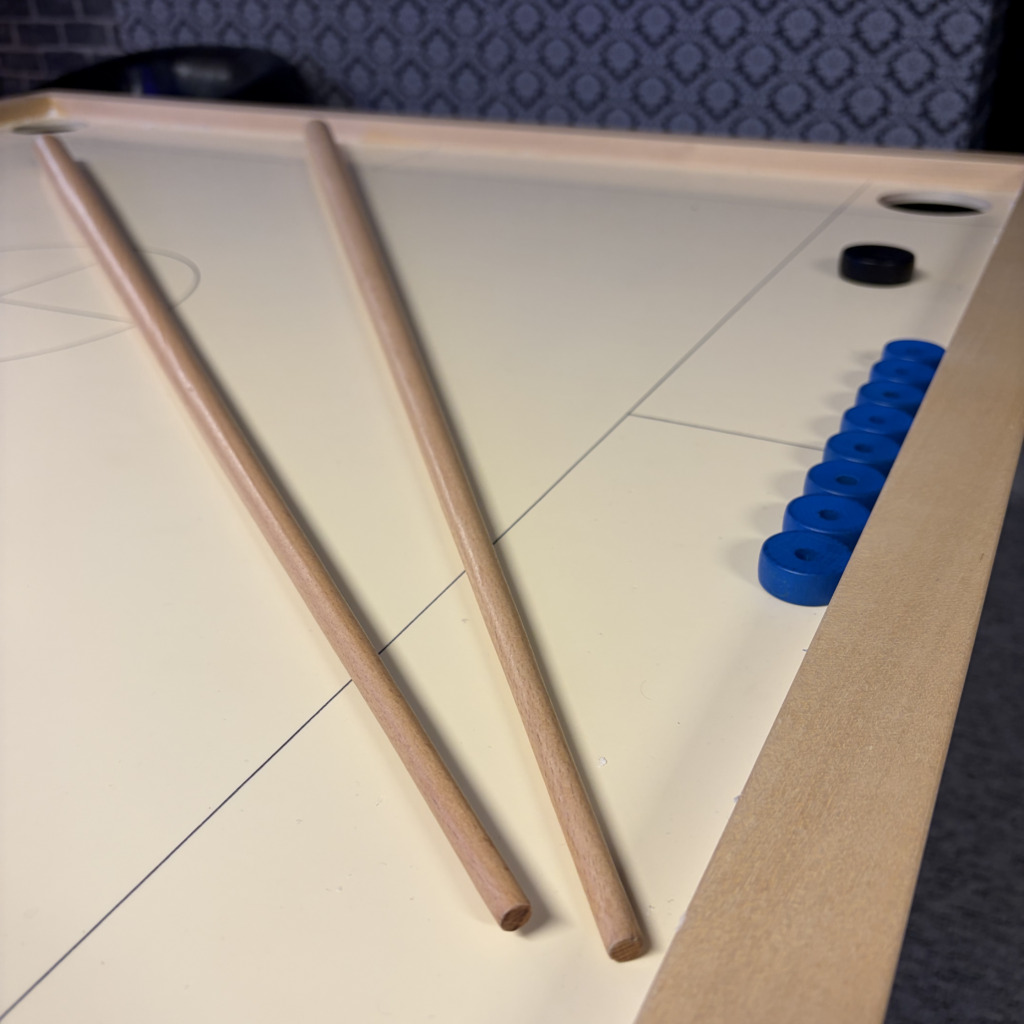
Many Estonians know koroona from their childhood. It’s a table game a little like billiards, but played on a smaller board with a cue and a striker disc. The aim is to knock the discs of your colour into the pockets in the corners of the board.
The game comes from South Asia, where similar table games were played long ago. From there it spread to Europe and became especially popular in the Baltic and Nordic countries. In Estonia, koroona boards could be found in schools, youth centres and homes.
Koroona’s charm lies in its simplicity. The rules are fairly easy to learn and understand even for a beginner, but playing well takes practice. Finding a good angle, using the right amount of force and thinking tactically give you the edge.
In recent years retro-style games have come back into fashion. People are looking for activities that don’t involve screens, and koroona offers exactly that. It’s a physical, social and at the same time calm game.
Its popularity has also grown because people enjoy spending time together. Koroona suits situations where people want to talk and do something at the same time. It doesn’t take much physical effort, but it keeps your attention.
Younger players often discover koroona for the first time, while older ones are reminded of their youth. This creates an interesting bridge between generations. Stories and memories come up around the board.
Koroona is also a good example of how simple games never really disappear. They may fade into the background for a while, but they always come back. When people look for real contact and shared moments, they find their way to games like this.
That’s why koroona is once again a favourite in many game rooms. It offers something a digital game can’t replace: real people, real emotions and real wins.